Buffalo Startup Ecosystem: A Founder's Guide (2026)
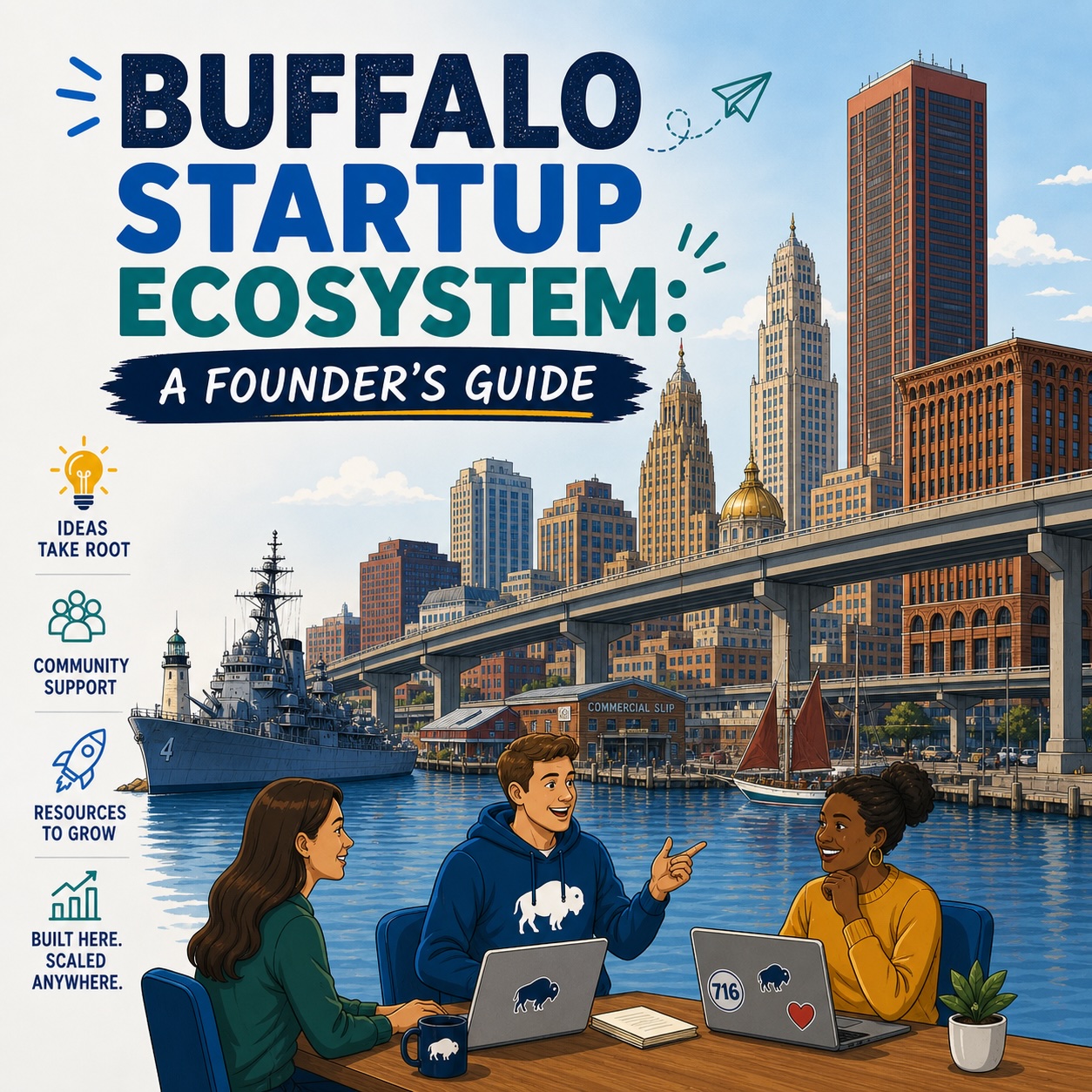
A founder's guide to the resources, programs, and organizations in the Western New York startup ecosystem.
What this is
The Buffalo startup ecosystem is rich with resources, but the alphabet soup is real. Several of the key entities sit under each other in ways that aren't obvious from the outside, and the names don't make the function legible. If you're a founder trying to figure out who actually does what for you, that's a real problem.
This guide groups the non-capital actors by what they actually do for founders. The boundary between "support resource" and "capital source" is fuzzy in places, so I included a few key financial resources which are integral to broader programs or organizations. But I do not attempt to map the broader capital landscape here; the region's seed/venture funds and PE vehicles deserve their own treatment.
The goal is simple: to introduce you to the key players and help you know who to call for what.
If you want a more exhaustive, filterable directory after this overview, Launch NY (covered in Section 2) maintains the Resource Navigator, a searchable database of more than 250 entrepreneurial resources across Upstate New York filterable by funding type, region, industry, and population served. It is the single best complement to this guide.
1. The university front door: UB Business and Entrepreneur Partnerships
If your venture has any connection to the University at Buffalo, student founder, faculty research, alumni, or just a need for university-level expertise or facilities, you start here. UB's UB Business and Entrepreneur Partnerships (BEP) is the front door to everything UB offers founders, regardless of UB affiliation. Per Stromhaug runs BEP as Senior Associate Vice President for Economic Development.
BEP runs several distinct programs:
UB Cultivator is UB's pre-seed accelerator. Two phases over nine months. Phase 2 companies can receive up to $100,000 in SAFE financing through the Buffalo Innovation Seed Fund, plus free co-working space at a UB incubator. Open to early-stage scalable startups headquartered in Erie, Niagara, Chautauqua, Cattaraugus, or Allegany counties. No prior UB affiliation is required. To date, Cultivator has worked with 66 companies and funded 28 of them, with more than 70% of recipients identifying as women or founders of color.
Buffalo Innovation Seed Fund is UB's broader venture capital fund, which writes both Cultivator Phase 2 SAFEs (up to $100K) and follow-on investments up to $250,000 in qualifying portfolio companies. It is a real venture fund with an external advisory board, not a grant program.
UB e-Law Center provides free legal services to UB-affiliated founders. Director Matt Pelkey. Scope covers entity formation, founder equity, and early advisory work. e-Law's free services are not a substitute for outside counsel for venture-track founders past seed; they are an entry point.
UB Incubators provide physical space and resources at the Baird Research Park (Amherst) and the Incubator @ CBLS in the Buffalo Niagara Medical Campus area. BNMC adjacency for life sciences, Baird for general technology and engineering. Wet lab space, fume hoods, and proximity to clinical research at Roswell or UB Medical are available at CBLS.
Startup and Innovation Collaboratory (CoLab) powered by Blackstone LaunchPad is UB's student-facing entrepreneurship hub. Open to all UB students at any stage, free, no equity. Programming includes ideation workshops, the LaunchPad Pitch Series, and connection to the Blackstone national network. Through Blackstone's national network, students also gain access to Techstars' mentor network, events, and start-up services.CoLab also hosts UB's two student business plan competitions:
- Panasci Technology Entrepreneurship Competition (Panasci TEC) is UB's annual student business plan competition, in its 26th year in 2026. Funded by a $1M endowment from the late Henry A. Panasci Jr. (founder of Fay's Drugs). Open to UB students across all disciplines. First place receives $25,000 in cash plus $40,000 in in-kind services from a rotating set of professional services and coaching partners, plus BEP co-working space. Second place receives $10,000. New for 2026: a $5,000 BEP Innovation Prize. Application deadline typically January 5; finals at UB Center for the Arts in April. Panasci is the most lucrative student competition in WNY by a meaningful margin.
- WNY Student 2 Biz Challenge is the regional collaboration of WNY colleges and universities run as the WNY regional feeder for the New York Business Plan Competition (see Section 12). Categories include clean technology and advanced technology. Winning regional teams advance to NYBPC.
Centers of Excellence and Centers for Advanced Technology are state-designated research centers that connect industry to UB faculty for applied R&D. The Center of Excellence in Bioinformatics and Life Sciences (CBLS) and the Center of Excellence in Materials Informatics (CMI) are the most active for founder use. Engagement is typically project-based and contractual, not equity.
StartingLine Startup Essentials is a free three-week virtual course for aspiring and early-stage entrepreneurs. Open to anyone, no UB affiliation or prior startup experience needed. UB faculty and industry professionals lead virtual breakouts, presentations, and expert panels, culminating in an in-person Pitch Day. Useful as a structured introduction to startup fundamentals for first-time founders.
SBIR/STTR support is housed at BEP. Staff help applicants strengthen commercialization plans, and the WNY Incubator Network (see Section 6) covers consultant costs for qualified Phase I and Phase II proposals.
If you're not sure which program fits, BEP staff will route you.
2. The pre-acceleration capital and mentorship layer: Launch NY
Launch NY is perhaps the most important resource in the ecosystem for most founders. It is a 501(c)(3) venture development organization and a U.S. Treasury-designated Community Development Financial Institution (CDFI). It serves 36 Upstate New York counties, is structurally independent of any university or municipality, and is the most active seed investor in New York State. Launch NY's CEO is Marnie LaVigne, PhD. Cumulative through 2025: 1,900+ companies served, $1.5B+ raised by portfolio companies, $275M+ in annual portfolio revenue, 9,900+ jobs supported. More than 70% of portfolio companies are in low-income neighborhoods.
What Launch NY actually delivers, in order of how most founders interact with them:
Entrepreneurs in Residence (EIRs) provide free, confidential, hands-on mentorship to high-growth-potential companies. EIRs are seasoned operators and investors, not generalist business coaches. The mentorship relationship is the front door to everything else Launch NY offers.
Seed investment through the InvestLocal Financing Programs, which are Launch NY's seed investment vehicles for early-stage Upstate startups. Launch NY has funded 110+ companies through these programs, including ACV Auctions in its earliest days.
Resource Navigator is Launch NY's filterable directory of more than 250 Upstate entrepreneurial resources, sortable by funding type (debt, equity, grants), region, industry, and population (women-owned, minority-owned). The single most useful supplement to this guide for founders looking beyond the headline players.
Founders Go Big is designed for under-resourced entrepreneurs at the earliest stages of business growth. The program bridges the critical gap between idea and investability by providing founders with expert guidance from a program team, access to funding opportunities, and a community of peers. Founders receive personalized support tailored to their unique growth path, preparing them to secure seed-stage capital and scale their businesses.
Emerging Cleantech Opportunity (ECO) 2.0 Incubator initially funded by the New York State Energy Research and Development Authority (NYSERDA), supports Upstate NY startups developing clean energy and resilience solutions. The program equips founders with mentorship, access to capital, and connections to industry sector resources, accelerating their path to market and long-term growth.
Technical Assistance Program (TA) provides founders with the specialized expertise and guidance needed to access funding and strengthen their businesses. Supported by the federal State Small Business Credit Initiative (SSBCI), the TA Program offers no-cost services to help entrepreneurs navigate legal, accounting, and financial challenges that often stand between them and investment. Through this program, eligible startups and small businesses receive hands-on advising from trusted professionals – whether they’re preparing to apply for capital through SSBCI or simply looking to get their business investment-ready.
3. The accelerator: 43North
43North is Buffalo’s flagship startup accelerator, led by Colleen Heidinger. It runs a single, highly selective annual cohort: each year, five companies receive $1M in exchange for 5% equity and participate in a year-long program. In return, companies are required to establish a meaningful presence in Buffalo, including relocating leadership and a portion of their team for at least one year.
The program is not designed for idea-stage founders. It is for companies that already have a product, early traction, and a credible path to scale. Application timing is annual, with a national (increasingly global) applicant pool and a highly competitive selection process. For founders at the right stage, it is the single largest non-dilutive-adjacent capital injection in the region paired with strong signaling value.
The accelerator’s impact is anchored by companies like ACV Auctions, which scaled from the inaugural cohort to a multibillion-dollar public company. Across cohorts, 43North portfolio companies have collectively raised over $1B and created thousands of jobs, with a growing share located in Buffalo.
Separate from the accelerator itself, the 43North Foundation, led by Sarah Tanbakuchi-Ripa and capitalized largely from ACV Auctions IPO proceeds, has launched a $100M / 10-year reinvestment plan for WNY. The Foundation exists to reinvest in the regional startup ecosystem across areas like talent, company creation, and corporate engagement. These efforts are related to—but distinct from—the core accelerator. The Foundation describes its work as four focus areas: a venture studio, talent, corporate connectivity, and storytelling. The accelerator continues to run annually as described above, separate from but related to the Foundation's four areas.
Radial Ventures is the venture studio arm of the 43North Foundation. Unlike accelerators (which admit existing startups) or venture funds (which invest in them), a venture studio participates directly in building companies—working at the earliest stages to develop ideas, shape products, and assemble founding teams before spinning ventures out as independent companies. In practice, Radial operates as an internal company-building function within the Foundation’s broader ecosystem strategy, with involvement from experienced operators such as Dan Magnuszewski. It is not a cohort-based program with a standard application funnel, but it is also not strictly closed: founders with strong ideas or domain expertise may still find ways to engage, particularly where there is alignment with Radial’s focus areas. Founders should think of Radial less as a program to apply to and more as a potential partner in very early-stage company formation.
TechBuffalo is the talent focus area (see Section 5).
Series B(uffalo) is the storytelling focus area, run editorially by former Buffalo Business First reporter Dan Miner. Modeled on the coordinated regional storytelling efforts of Salt Lake City and Indianapolis.
43N Compass is 43North's talent and recruitment program, distinct from the Foundation's talent focus area, which runs through TechBuffalo. Compass is a job board featuring openings at 43North portfolio companies and other Buffalo startups, plus a Talent Network founders can use to source candidates. Christian Gaddis is the recruitment manager. Covered further in Section 5.
For founders, 43North is not the answer to "I need help getting started." It's the answer to "I have a product, I have customers, and I'm ready to scale with capital and a Buffalo footprint."
4. The free legal services landscape
Three organizations provide free legal help to founders and small businesses in Western New York. They serve different populations and you should know which one fits your situation.
UB e-Law Center (covered in Section 1) is for UB-affiliated and BEP/Cultivator-program founders. Pre-institutional-capital scope. Directed by Matthew Pelkey.
Launch NY SSBCI Technical Assistance Program (covered in Section 2) is for any pre-seed or seed-stage New York startup. No UB affiliation required. Statewide. Legal services include entity formation, contracts, employee agreements, ownership transfers, and equity fundraising.
Small Business Legal Clinic (SBLC) is for low-income entrepreneurs (means-tested). Scope is small-business operating work: business formation, contracts, commercial leases, licensing, permits, zoning, buying/selling/closing a business, corporate governance and compliance, tax considerations, and M/WBE certification. Drop-in clinics monthly at WEDI's West Side Bazaar (1st Tuesday), the Beverly Gray Exchange (3rd Wednesday), and the Women's Business Center (2nd Wednesday), plus virtual clinics. Phone 716.828.8457. WNYLC's other practice areas are housing, consumer debt, and foreclosure defense, which gives you a sense of the population they serve.
Free legal services are increasingly available in WNY for first-year-of-formation work. They are not a substitute for engaged outside counsel through institutional fundraising rounds or for ongoing securities and corporate work, but they are real, and founders who qualify should use them.
5. The talent layer
TechBuffalo is the regional nonprofit dedicated to building tech talent density in WNY. Operates as the talent focus area of the 43North Foundation, with additional ESD funding and WNY Impact Investment Fund as an investor (PitchBook records ~$5M raised). President & CEO is Jeffrey Botteron (since September 2024). For founders, TechBuffalo's most relevant programs are the annual Women in Tech WNY conference (March), agtech meetups, and PowerUpTech (Buffalo's premier summer internship experience for tech students). TechBuffalo also operates as the strategic partner for the Buffalo Niagara Partnership's Tech Industry Leaders Forum, runs the Tech Workforce Dashboard, and maintains a useful directory of WNY tech meetup groups that is more comprehensive than what's listed in this guide.
43N Compass (formerly Forge Buffalo) is 43North's talent program: a job board for openings at 43North portfolio companies and other Buffalo-area startups, plus a Talent Network for candidates who want to be discovered by founders and hiring managers. Useful for founders both as a posting venue when hiring and as a candidate pipeline.
WNY Sophomore Externship Experience (SEE) is a UB CoLab program (funded by the Bryant Foundation) that matches local college sophomores with paid summer externships at WNY companies. Externs receive $4,000 stipends; host companies pay nothing. Application window for host companies typically closes February 1. Useful for founders who want exposure to early-career talent without the budget overhead of a full intern program, and for catching strong students before they're locked in elsewhere.
Be in Buffalo is a program of Invest Buffalo Niagara (see Section 10). Talent attraction campaign aimed at convincing remote tech professionals and out-of-region workers to move to (or move back to) Buffalo. Marketing-led, not a direct service for founders, but useful if you're recruiting senior talent from out of region. Includes a Relocation Guide, Cost of Living Calculator, and the Be in Buffalo Ambassador Program.
Northland Workforce Training Center is the advanced manufacturing workforce pipeline anchor on the East Side, operated under BUDC's Northland Corridor redevelopment. If you're building anything that touches advanced manufacturing, energy storage, or skilled trades, Northland is the local talent training source.
6. Incubator space and the WNY Incubator Network
If you need physical space to build your business, it is worth first distinguishing a startup incubator from a standard coworking office. While coworking provides flexible desk space and shared office infrastructure, an incubator is a programmatic, growth-oriented resource. Incubators offer subsidized, milestone-based lease terms, access to specialized facilities (like wet labs, fume hoods, or prototyping equipment), structured mentorship, and direct pipelines to institutional funding. They typically require an application process and are designed to accelerate an early-stage company toward commercial viability. If you need this level of specialized, structured infrastructure, three institutional incubators are the main options in WNY, and they are coordinated under one network.
WNY Incubator Network (WIN) is the cross-incubator coordination body, managed by UB BEP. Funded through the NYSTAR Innovation Hot Spot program and chartered by the WNY Regional Economic Development Council. Serves Allegany, Cattaraugus, Chautauqua, Erie, and Niagara counties. WIN connects startups across its member incubators to UB resources (faculty expertise, student talent, programs, equipment), administers the SBIR/STTR consultant cost reimbursement program, and partners with BootSector on Pitch-In events. Founders interacting with any WIN-affiliated incubator have access to the broader network. Their page contains a list of other incubator spaces in the region.
The two member incubators outside UB itself are: UB Incubator @ Baird Research Park (Amherst, near UB North Campus) and UB Incubator @ CBLS (701 Ellicott Street, BNMC area) are covered in Section 1. Baird for general technology and engineering, CBLS for life sciences with wet lab access.
SUNY Fredonia Center for Innovation & Economic Development (CIED) is the regional incubator for Chautauqua County and the Southern Tier, located at 214 Central Avenue in Dunkirk's central business district. Formerly known as the Fredonia Technology Incubator (FTI). NYS-certified business incubator, founded 2007. 22,000 sq ft LEED-certified building. Director Chuck Cornell. Houses Chautauqua County IDA's Planning and Economic Development Department, serves as a StartUp NY location, and runs an annual Student Business Competition with $1,200 grand prize plus office space at the incubator. Focus on arts, food, and technology-based startups. ~11 businesses in residence as of recent years. If your venture is in Dunkirk, Fredonia, or anywhere in Chautauqua County, this is your local institutional incubator and the closer relationship than UB's North Buffalo locations.
The Rookery Labs at 683 Northland Avenue is a sector-specific incubator for medical device companies.
The Foundry at 298 Northampton Street is a community-makerspace incubator focused on product/maker businesses (covered in Section 11). Both operate separately from WIN.
Buffalo Game Space is a non-profit dedicated to running events, workshops, a co-working space, and providing educational, mentorship, and equipment resources to both professional and aspiring game developers.
BootSector (described below in Section 7) maintains a list of local incubators on their website as well.
Coworking offices such as Serendipity Labs (at Seneca One), Hansa (on Ellicott Street), or Skeleton Dojo Social Club (on Elmwood and Lafayette) offer flexible workspaces, shared amenities, and a network of entreprenuerial-minded neighbors without the structured programming, application barriers, or milestone requirements of an incubator. These spaces are ideal for remote workers, distributed startup teams, or founders who simply need professional office infrastructure, high-speed internet, and an active community of peers without the formal guardrails of a specialized institutional program.
7. The community of practice and event infrastructure
Buffalo Open Coffee Club (BOCC) is the longest-running and most consistent informal gathering in the WNY ecosystem. Free. No agenda, no programming. Founders, operators, investors, and service providers show up at Seneca One every Tuesday morning, 7:30 to 9:00 AM, drink coffee, and talk. Co-organized by Zack Glick. BootSector provides backbone support and BOCC sometimes runs under the parallel name "Buffalo Startup Coffee." For new founders looking for the lowest-friction way into the ecosystem, this is it.
Buffalo Code & Coffee is a developer-side community started February 2025 by Noah Harris, Steve Chen, and Zack Glick. Biweekly meetup framed primarily as programmers helping other programmers: people show up to work on personal projects, get help with coding blockers, prep for interviews, or hang out. Recent meetings have been at UB Davis Hall and rotating sponsor venues. Not a recruiting venue, but if you're a technical founder yourself, it's a community of working engineers worth knowing about.
BootSector is a Buffalo-based 501(c)(3) founded in 2021 by Clark Dever, Jack Greco, and Jordan Walbesser. BootSector's mission is to empower, educate, and support the next generation of local entrepreneurs and startup leaders. In practice, this means BootSector is the nonprofit backbone for founder-led startup events in Buffalo (and Rochester): providing financial grants to community organizers and handling payment processing, tickets, insurance, donations, and marketing support. Sponsors include Douglas Development, Foundry, and ACV Auctions.
BootSector also runs programming including:
- Pitch-In, a recurring early-stage pitch practice event open to founders at any stage. Three founders pitch, audience asks questions and gives feedback. Co-presented with the WNY Incubator Network.
- WNY AgTech Meetup, monthly meetup for agtech founders, farmers, investors, and experts.
- BootUp:AI, a new program funded by a $40K Springboard 2025 award.
- Backbone support for Buffalo Startup Week (the annual ecosystem programming week, expanded in 2026 to April 15-23 and powered jointly by WIN and UB BEP), Buffalo Startup Weekend, Buffalo Startup Wednesdays, Startup Grind Rochester, RocGrowth, and Buffalo Open Coffee Club.
If you want to start a new founder-led event or community in Buffalo and you need backbone services so you can focus on programming rather than logistics, BootSector is the entity.
WNY Venture Association (WNYVA) has been the region's pitch-and-investor forum since 1989-1990. Five forums per year, each featuring two pre-screened companies giving twenty-minute presentations (ten-minute pitch + ten-minute Q&A) plus a few one-minute pitches from earlier-stage companies. Open to anyone interested. Coaching is provided to presenting companies. WNYVA forum presentations are also the gateway to pitching the Buffalo Angels, WNYVA's accredited-investor subgroup (~70 members, $3.5M+ deployed since 2013, $14M+ in leveraged co-investment). Executive Director: Jack McGowan (also at Insyte Consulting). For a founder, WNYVA is the most direct path in WNY to get in front of local investors and operators with a structured presentation.
Other WNY tech communities worth knowing about, particularly for hiring or technical learning: Buffalo Data Science Community (BDSC), Buffalo Game Space (501(c)(3) for game developers), and the Women in Tech WNY meetup network. TechBuffalo's WNY Tech Communities page is the most current directory.
8. Education, training, and post-product-market-fit support
SCORE Western New York is the local SBA-supported chapter of SCORE, the nation's largest network of free, expert business mentors. The Buffalo Niagara chapter has 50-70 volunteer mentors (working and retired executives, entrepreneurs, and industry specialists) who provide free, confidential one-on-one mentoring across every aspect of business planning, start-up, management, and growth. Free and low-cost workshops throughout the year. Co-sponsors Straight Talk with the SBA each January and EXPO/Matchmaker each May. Serves the eight counties of Western New York. Like the SBDCs (see below), SCORE is most useful for SMB and operating-business founders rather than venture-track founders, but the format is different: SCORE pairs you with an individual volunteer mentor whose background matches your need, rather than a staff counselor.
UB Center for Entrepreneurial Leadership (CEL) is UB School of Management's long-running entrepreneurship education and peer-mentorship center, established 1987. CEL is not for venture-track founders raising institutional capital; it is for practicing operating-business owners and growth-stage entrepreneurs who want structured peer learning, mentorship from seasoned operators, and a community of WNY business owners. 1,400+ alumni who collectively employ 23,000+ Western New Yorkers across businesses worth $2.3B+ to the local economy. Programs include:
- CEL Core, the flagship peer-based, mentor-driven program for established entrepreneurs.
- M&T Bank Minority and Women Emerging Entrepreneurs (MWEE), focused on advancing minority- and women-owned businesses to the next development stage.
- Startup CEL, specialized programming for early-stage companies.
- Mastery Forum, a coach-facilitated continuation program for Core graduates.
- Key Persons Leadership Development, Family Business, and other targeted offerings.
For founders who fit the profile (operating businesses past initial formation, looking for structured education and a peer cohort of WNY operators), CEL is the regional standard. CEL is distinct from the Golisano Institute below; CEL educates working entrepreneurs through short-form programs, Golisano educates entry-level talent through a two-year certificate.
Golisano Institute for Business & Entrepreneurship is the newest major institutional addition to the WNY ecosystem. Founded in 2023 by Tom Golisano (founder of Paychex and former Buffalo Sabres owner) and run by President is Ian Mortimer, the institute is a separately-licensed two-year professional certificate program designed as a more affordable, targeted alternative to traditional (e.g., bachelors degree or MBA) business education. Flagship campus is in Rochester; a second campus opens in fall 2026 at 125 Washington Street in downtown Buffalo (the former Buffalo News building), with first programs expected in August this year.
The Buffalo campus will offer a two-year Professional Certificate in Business & Entrepreneurship, a one-year Advanced Certificate in AI & Business, and a shorter Certificate in AI & Business. The two-year program requires three internships, which is the program element most relevant to founders: the institute is actively building partner employer networks in Buffalo, and founders looking for affordable, business-oriented interns should be on Golisano's partner list (contact John Mordaci, VP of Partnerships). Golisano also hosts startup programming on its campus through its Businesses in Residence program, including the Revenue Accelerator described next.
GrowthX: The Revenue Accelerator at Golisano Institute is a 16-week sales coaching program for WNY startups. It's run as a partnership between Golisano Institute and GrowthX, a go-to-market advisory firm. Currently based at the Rochester campus; expected to expand to Buffalo with the new Golisano campus. Cohorts are 15 companies drawn from Rochester and Buffalo. This program is especially useful for founders past initial commercialization who don't need formation help anymore but do need disciplined sales coaching to build repeatable revenue.
Small Business Development Centers (SBDCs) at Buffalo State University and Niagara County Community College provide free counseling and training to small business owners. Particularly useful for SMB and operating-business founders working through standard small business needs (loans, government contracting, basic financial planning) rather than venture-track founders.
9. For-profit founder services
A handful of WNY-based for-profit firms specifically serve founders and early-stage companies. Brief introductions oriented around what each one's value proposition actually is for founders; this is not exhaustive.
VMG Business Advisory (Connor Godfrey). Buffalo-based business law and advisory practice for venture-track founders, SMBs, investors, and nonprofits. Combines transactional legal work with business advisory across formation, financing, M&A, and outside general counsel relationships.
Business Growth Accelerator (Anna Tomani, Mike Neal, Shatara Levy, and Marcus J. Moses). Provides a half-day workshop for entrepreneurs and small business owners, focused on growing their business across lead generation, networking and referrals, and CRM/follow-up automation.
Board Bonsai (Matt Haberstro). For solo founders and small teams, Board Bonsai works alongside you each week to keep the business moving: setting priorities, tracking what got done, and turning the things in your head into written-down systems your team can run on their own.
Finsightic Back-office finance and operational support for startups and growing businesses. Finance (bookkeeping, controller, fractional CFO, catch-up & cleanup) and operations (SOPs, workflow design, CRM/ERP implementation); the value is for founders who need both their finance function and their core operating systems professionalized at the same time.
This list is intentionally short. There are more consultants, fractional executives, and professional service firms working with WNY founders, and any list is incomplete. The point is that founders in Buffalo have for-profit professional service options beyond the nonprofit programs in this guide.
10. Place-based and infrastructure organizations
Two of the most important institutional players in the WNY business ecosystem are tightly coupled and worth understanding together. Buffalo Niagara Partnership (BNP) is the regional chamber of commerce and privately-funded economic development organization (membership-based, ~250,000 employees represented across member companies). Invest Buffalo Niagara (IBN) is the regional business attraction and site-selection organization. IBN is a strategic partner of BNP (BNP's own framing describes IBN as an "extension of the BNP"). For founders, these are functionally distinct: BNP for policy advocacy, member networking, and convening; IBN for site-selection, incentives, and inbound business attraction. President & CEO of BNP is Dottie Gallagher. President & CEO of IBN is Thomas A. Kucharski.
For founders specifically, BNP is most useful for policy engagement, the Tech Industry Leaders Forum (with TechBuffalo as strategic partner), and corporate-buyer connections at scale. IBN is most useful if you're considering relocating to Buffalo, evaluating a second site, or working on a deal involving incentive packages, workforce data, or international expansion. Be in Buffalo (Section 5) is an IBN program.
The other major place-based and infrastructure organizations:
Buffalo Niagara Medical Campus (BNMC) is the 120-acre downtown medical and research district. UB Medical School, Roswell Park, Kaleida, and dozens of life sciences companies. BNMC operates innovation programming, networking events, and adjacency-driven facilities access. For life sciences founders, BNMC is both a location and a community.
Empire Discovery Institute (EDI) is the life sciences commercialization partnership among UB, Roswell Park, and the University of Rochester. $47M capitalization ($35.4M from ESD plus $12M from the institutional partners). CEO Ron Newbold. EDI takes early-stage faculty research from the three institutions and develops it toward commercial viability through a structured pipeline. Partnerships with Deerfield (the ED³ program), Novo Nordisk (LeapRx), and the National Multiple Sclerosis Society (Fast Forward). For life sciences founders spinning out of UB or Roswell, EDI is the formal pathway.
Roswell Park Comprehensive Cancer Center does not operate its own incubator, but its Technology Transfer & Commercialization office runs a substantial portfolio of spinout companies (Canget, Cleveland BioLabs, Empire Genomics, Tartis, and others). For founders building on Roswell-licensed technology, the path runs through Roswell tech transfer plus EDI.
Erie County Industrial Development Agency (ECIDA) and Niagara County Industrial Development Agency (NCIDA) are the local IDAs. They provide tax incentives (PILOT, sales tax exemption, mortgage recording tax exemption) and bond financing for capital projects. Relevant for any founder doing a real estate-heavy build-out, manufacturing footprint, or major capital expenditure. Not relevant for software or services companies in early stages.
11. Community-based small business support
These organizations focus on small business and microenterprise founders, particularly those operating outside the venture-backed startup track. They serve immigrant entrepreneurs, women entrepreneurs, makers, and founders building neighborhood-anchored businesses. Useful both as direct resources and as referral channels for founders who are not venture-track.
The Foundry is a 501(c)(3) makerspace and small business incubator on Buffalo's East Side at 298 Northampton Street. A project of Net+Positive (its parent 501(c)(3)). Buffalo's first community makerspace. Houses ~30 maker businesses per year as residents through its Foundry Fellow program (paid monthly residency that includes private workspace, makerspace access, mentorship, and business programming). Mission orientation toward low-income, minority, women-owned, and neighborhood-based businesses. Particularly strong in product-based and craft businesses (woodworking, upholstery, leatherworking, glassblowing, etc.). The Foundry also runs youth STEAM and entrepreneurship programs and hosts a monthly Small Business Legal Clinic in partnership with WNYLC's SBLC and The Exchange at Beverly Gray.
Westminster Economic Development Initiative (WEDI)'s West Side Bazaar (1432 Niagara Street) supports immigrant and refugee entrepreneurs, primarily in the food and retail trades. WEDI runs the Bazaar itself as an incubator-style commercial space and provides business incubation support, a microloan program, and ESL programming. Hosts WNYLC's SBLC drop-ins on the first Tuesday of each month.
The Exchange at Beverly Gray (334 East Utica Street) is an East Side small business support center, with a focus on Black entrepreneurs and East Side neighborhood businesses. Hosts WNYLC's SBLC drop-ins on the third Wednesday of each month, plus virtual clinics by appointment (716-800-2171).
Women's Business Center (WBC) at Canisius University at 1901 Main Street is part of the SBA's national network of Women's Business Centers, which provide counseling, training, and capital access support specifically for women entrepreneurs, with priority for economically disadvantaged women. The Buffalo WBC hosts WNYLC's SBLC drop-ins on the second Wednesday of each month, plus virtual clinics.
Good Neighbor Fund provides $1,000 microgrants to under-resourced founders in Buffalo and Denver. Eight grants per year. Founded by Jason Bartz and Susan O'Rourke (both ex-ACV Auctions). For founders who are too early for any institutional check, this is the lowest-friction first dollar in the ecosystem.
12. Statewide connective tissue
Two organizations span the entire Upstate ecosystem and are worth knowing for founders who want connections beyond Buffalo.
Upstate Venture Connect (UVC) is a 501(c)(3) founded by TriNet founder Martin Babinec. CEO Olivia Goldstein. UVC is the relationship layer connecting Upstate founders to mentors, advisors, and capital across the state. Programs include UNY50 (an invitation-only network of senior entrepreneurs and operators), Community Advocates (regional connectors in each Upstate metro), and Founder Fusion events including Upstate-to-NYC and Upstate-to-DC dinners. UVC won a $100K Springboard 2025 award for an Upstate-to-DC Founders Roadshow. If you want to be known beyond Buffalo, UVC is the entity that makes that happen.
Upstate Capital Association of New York is the capital-side counterpart to UVC. Connects capital providers, professional advisors, and supporting organizations across Upstate. Most relevantly for founders, Upstate Capital runs the New York Business Plan Competition (NYBPC), the largest intercollegiate entrepreneurship competition in NYS: 10 ESD regions, 6 tracks, top two teams per track per region advance to state finals, $25K Grand Prize, ~$100K total prize pool. Eligibility: currently enrolled NY college students with majority-student-owned ventures and under $100K in cumulative capital raised.
How to actually use this
If you're starting from zero, the practical order of operations for a founder might be:
Show up to the Buffalo Open Coffee Club. Get coffee. Talk to people. It's the lowest-friction way to start meeting people in the ecosystem.
Contact Launch NY for an EIR conversation, or BEP if you are UB-affiliated.
If you're pre-pre-seed or under-resourced, talk to the Good Neighbor Fund. The microgrant is $1,000 with no strings.
If you need physical incubator space, look to the university-affiliated incubators, various industry-focused incubators, or coworking offices.
If you're ready to pitch local investors, contact WNY Venture Association.
If you're ready to create a business entity, draft your initial contracts (NDAs, equity for contributors and IP assignment, or fundraising documentation), or want help refining your business plan, contact VMG Business Advisory.
If you find yourself wanting more after this guide, Launch NY's Resource Navigator contains 250+ resources is a natural next step.
The ecosystem is rich with resources and opportunities. Use it.
Have a question or proposed edit? Find me at [email protected].