The New York LLC Publication Requirement, Explained
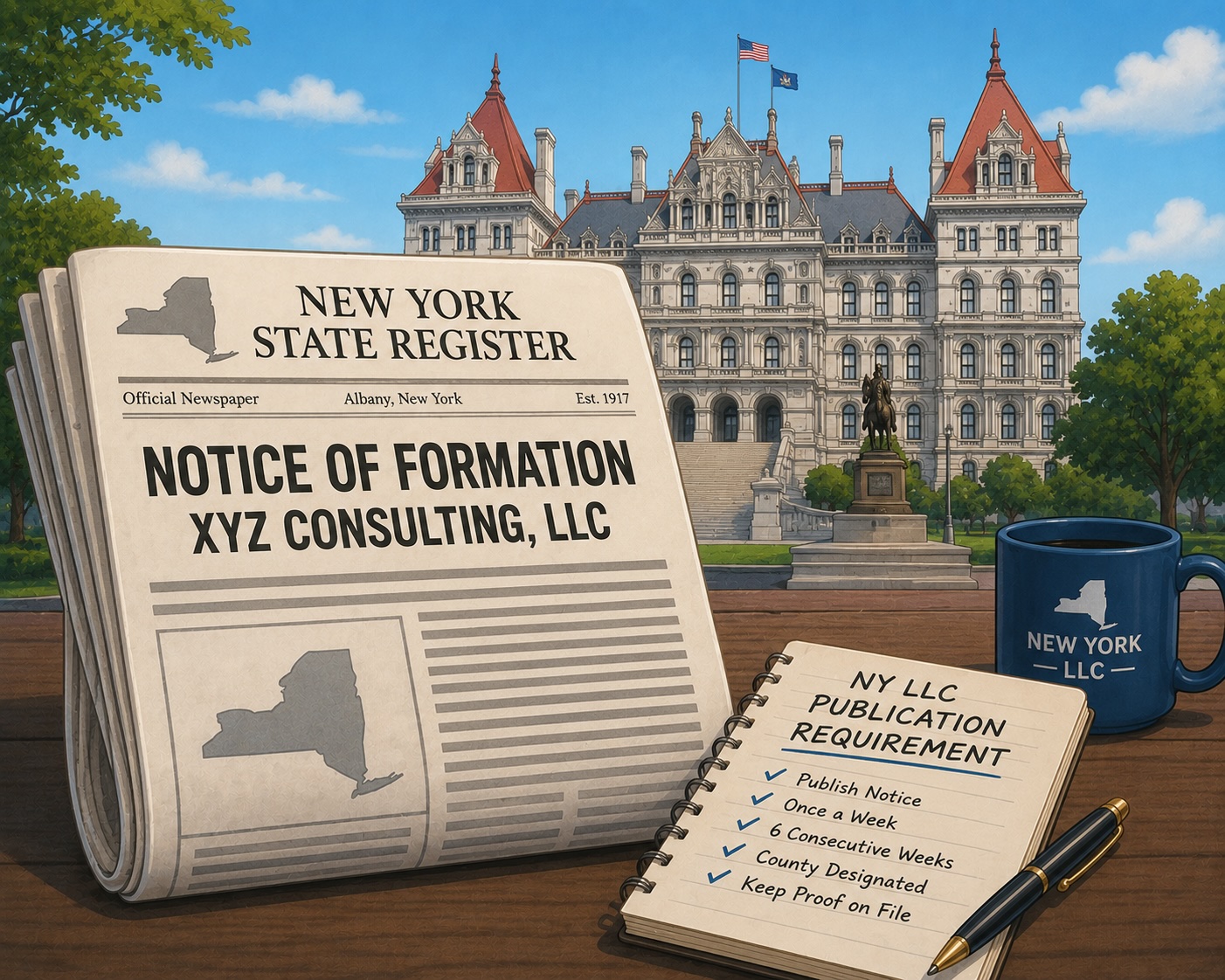
In most states, forming an LLC is one step: file, pay, done. New York kept a second step from an earlier era. After you form (or register) an LLC here, you must announce it in the newspaper. Twice over, for six weeks, in papers you don't get to choose, at prices that vary wildly by county.
It is a predictable, one-time cost, but only if you know about it before you file. Budgeted at formation, it is a line item. Discovered afterward, it is an unwelcome invoice arriving when you thought you were finished.
What § 206 Actually Requires
Under Limited Liability Company Law § 206, within 120 days after your articles of organization become effective, the LLC must:
- Publish a notice (or a copy of the articles) once per week for six successive weeks,
- in two newspapers in the county where the LLC's office is located per its articles, one printed daily and one printed weekly,
- with the papers drawn from those the county clerk designates for that county, so your choice is limited to the clerk's approved list rather than any paper you like,
- then file a Certificate of Publication with the Department of State, with the newspapers' affidavits of publication attached and a $50 filing fee.
The same requirement applies to out-of-state LLCs that register to do business in New York, measured from the filing of their application for authority. Corporations, for what it's worth, do not publish; this is an LLC (and LP) ritual.
What It Costs: The County Is Everything
The state's fee is only the $50 certificate. The real cost is the newspaper advertising, and because the county clerk designates the papers, the county named in your articles sets your price. Budget a few hundred dollars in most of the state, and materially more in New York City, where the designated dailies are among the most expensive places in the country to run a legal notice. Rates move, and they depend on which papers the clerk assigns, so get a current quote before you file.
You can arrange publication yourself (call the county clerk for the designated papers, then order the notices) or pay a publication service a modest markup to handle the whole sequence and the affidavits.
The Albany Address Question
Because the bill follows the county designated in your articles, a cottage industry exists around designating a low-cost county (commonly Albany) as the LLC's office, often via a registered agent's address, and publishing there at a fraction of the Manhattan price. Founders ask about this frequently, so here is the even-handed version.
The county designation in your articles is what drives publication, and the statute does not require that designated office to be where you actually work. But there are trade-offs. The Department of State mails service of process to the address on file, so a legal complaint against your company routes through that address. In practice that means engaging a registered agent in the designated county and paying a recurring fee for the service, which offsets part of the one-time publication savings. And if you later amend your articles to move the designated county, you can trigger the publication requirement again in the new county, paying twice for the thing you optimized once. If the savings are large (a Manhattan business, for example), it is worth a conversation with counsel; if you are already in an inexpensive county like Erie, it is rarely worth the complexity.
What Actually Happens If You Skip It
If you do not complete publication within 120 days, the LLC's authority to carry on business in New York is suspended until you comply. The consequence that matters most: a suspended LLC cannot maintain an action or special proceeding in a New York court. Section 206 expressly preserves your right to defend a case, and preserves every right your counterparties hold against you, but it does not preserve your ability to sue. Courts have dismissed actions brought by LLCs that had not published. If a customer stops paying while you are suspended, you cannot enforce the contract until you cure.
What suspension does not do:
- It does not dissolve your LLC.
- It does not void your contracts or excuse counterparties from performing.
- It does not strip your limited liability. Section 206 imposes no personal liability on members for the company's failure to publish.
The statute sets no late fee and no penalty. Filing proof of publication annuls the suspension whenever it happens, so late compliance costs the same as timely compliance.
Beyond litigation, the suspension surfaces whenever someone checks: banks and lenders ask for the Certificate of Publication when opening accounts or extending credit; landlords, investors, and closing counsel ask during diligence. The typical failure mode is discovering the gap under deal pressure and fixing it in a hurry, at the same price you would have paid anyway plus the stress. It is a strange requirement, but it is a one-time, fixed-cost requirement. Treat it as part of the formation budget and it never becomes a story.
Don't Confuse Publication with the New Transparency Filings
Founders sometimes conflate the newspaper requirement with the wave of beneficial-ownership rules. As of mid-2026, the transparency picture is more forgiving than the headlines suggested: FinCEN's 2025 rule under the federal Corporate Transparency Act exempts U.S.-formed companies from beneficial-ownership reporting (only foreign-formed entities registered here report), and New York's LLC Transparency Act, effective January 1, 2026, was narrowed before it took effect and applies only to LLCs formed outside the United States that are authorized to do business in New York. A New York-formed LLC currently owes neither filing. Publication under § 206 is unaffected by any of this and remains fully in force.
The Practical Playbook
Budget publication with formation, not after it. When the articles are filed, get the designated papers from the county clerk (or hand it to a service) and start the six-week clock immediately, since the 120-day window is more comfortable at the front than the back. When the affidavits arrive, file the certificate with the $50 fee, and keep the filed certificate with your company records; you will produce it for every bank and every diligence list for the life of the company. Then you are done. Barring a change of county, you never publish again.
Conclusion
The publication requirement is New York's most reliable formation surprise: a real cost, a fixed cost, and a survivable one. Founders who know about it in advance budget a few hundred dollars (in Erie County) and move on. Founders who don't, meet it at the worst possible moment, usually across the table from a bank. Know the quirk, price it in, and it is paperwork rather than drama.
VMG Business Advisory quotes New York formation with publication costs stated up front and handles the designation, publication, and certificate filing as part of the engagement.
Related practice areas: Startup Advisory · Corporate Governance
This article is provided for general informational and educational purposes only. It does not constitute legal advice or create an attorney-client relationship. Publication costs are approximate 2026 figures and vary by county and newspaper; the information is current as of September 2026 and subject to change. Attorney Advertising.